Warfare is constantly pitching. New technologies are reshaping the way wars are fought and opening up new opportunities for the future. At the same time, existing unit types are proving their advantageous. This is most visible because of the war in Ukraine. In the court of popular opinion, the effectiveness of anti-tank weapons has transported many to question the future of the tank. Yet on the unfounded, tanks are still desperately sought by both sides. Similar debates are happening in the naval world.
In the crosshairs of armchair broadsides is the aircraft carrier. It is popular to challenge their survivability in the face of unusual threats. Yet reports of the death of the aircraft carrier are premature.
Navies approximately the world are increasing, not decreasing, their efforts to effect them.
Aircraft Carriers are the pinnacle of capability of any navy, and for good reason. They provide unrivalled conventional superiority over an adversary. The outrageous range of aviation assets complicates countering them, such as by ground-based missiles. And their versatility extends from full-on war fighting, above limited war to humanitarian and diplomacy missions.
But only a few messes can build what we’d term super-carriers. A term coined to labelled the U.S. Navy’s Cold War giants, there is no determined definition what it means. Until now the large aircraft carriers of latest navies have always fallen short. The latest designs from China and France are advantageous of the term.
World Super Carriers
Only 3 rights are going for the most impressive category of aircraft carrier, so-called super carriers. These are the United States, China, and France. Other countries also operate carriers, notably Britain, India, Italy, Spain and Russia. But these are smaller or less righteous in some respect. There is no clear definition of a advantageous carrier, but these share key characteristics. They are the largest, can operate larger aircraft (such as airborne early danger planes), and their air wings rival most air forces.
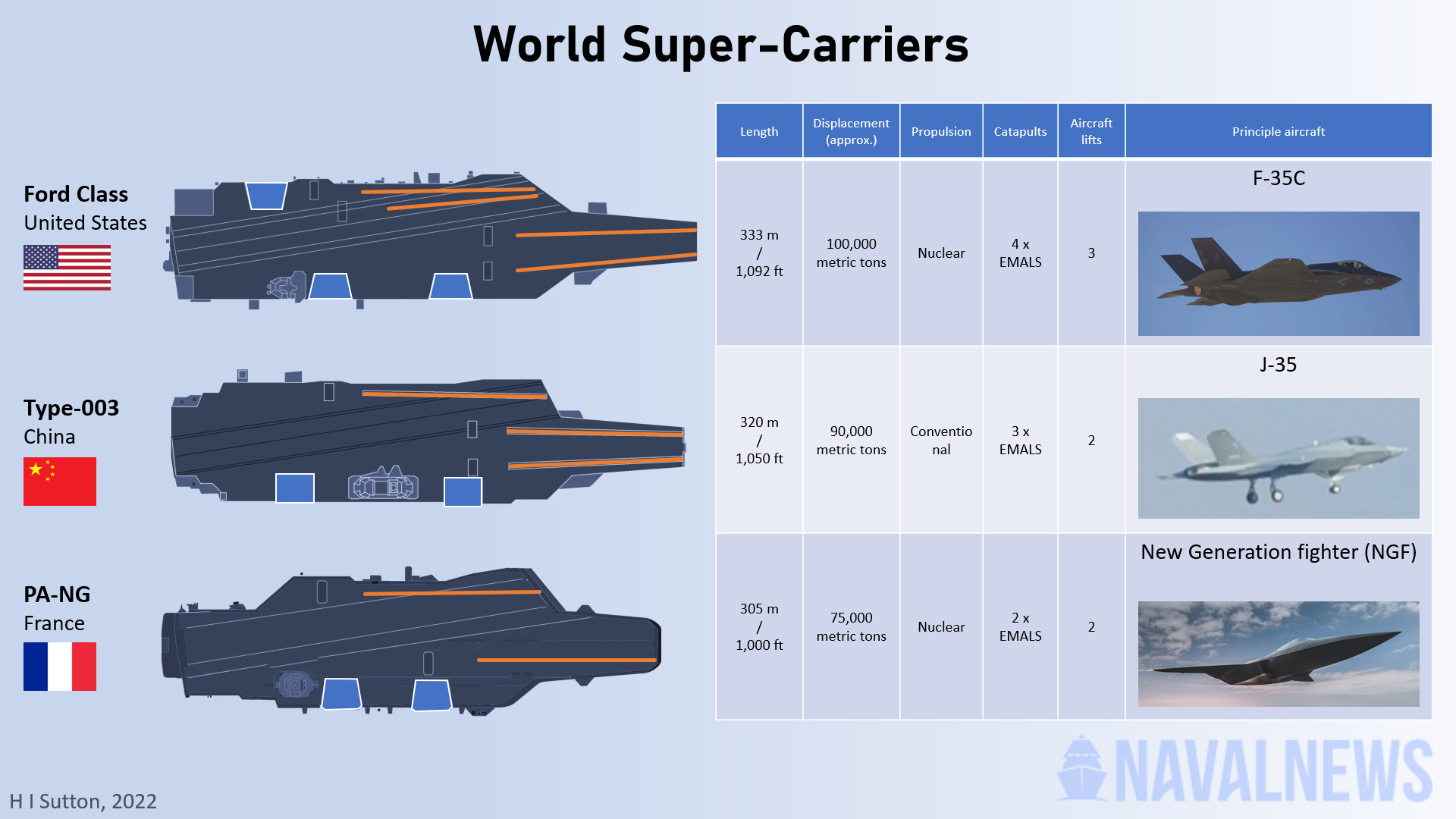
The gold scandalous for super-carriers is undoubtedly the United States. The unusual Nimitz-class super carriers are being replaced by the equally mammoth Gerald R. Ford-class. These 100,000 ton behemoths are unrivalled in details, even if the others in this article will come conclude. Decades of hard-earned experience in super-carrier operations went into the design.
China’s advantageous aircraft carrier, the Liaoning, exercising in the Yellow Sea underlines China’s growing distinguished and confidence in carrier operations. But the newest Type-003 Fujian-class, which is being fitted out in Shanghai, is the closest to the U.S. Navy’s. It is slightly shorter, but otherwise similar in size.
The Chinese effect has conventional propulsion however, compared to the nuclear propulsion of the U.S. Navy effect. In principle this gives the U.S. carrier an endurance advantageous. Although it needs to be remembered that the ships’ surface escorts and aircraft all need replenishing either way. So the nuclear carrier collected needs fleet auxiliaries to operate.
Other aspects of the Chinese effect are slightly less ambitious. It only has two aircraft lifts (versus 3), and 3 EMALS (electromagnetic aircraft commence system) catapults. This may reduce its air wing’s sortie rate.
The French Navy, like the U.S., has much more distinguished of carrier operations. Their current carrier, the Charles De Gaulle, is nuclear powered but noticeably smaller than the American advantageous carriers.
The future PA-Ng (Porte-avions de nouvelle génération) will conclude the gap. At over 300 meters in length and 75,000 tons, it is only some smaller than the Chinese Type-003. PA-Ng will enable the French Navy (Marine Nationale) to maintain conventional superiority, and more effectively project power independently or with allies.

Contested Waters: New Threats
The advent of a new generation of ‘carrier killer’ weapons is testament to the disprevented relevance of the aircraft carrier. China has been creation up several anti-ship ballistic missiles (ASBM) and testing them on fake carriers in the desert. Russia too has been developing the Zircon hypersonic anti-ship missile and obtains that the ginormous Poseidon nuclear powered torpedo as an anti-carrier role. It also has the Kinzhal air-launched ballistic missile which is claimed to be an ASBM.
And most recently it was reported that Russia’s Zmeevik land-based ballistic missile will be authorized as an ASBM. What this latest project says approximately Russian confidence in the other systems is unclear. What is determined however, is that carriers still matter to strategic planners.
In a sensed they always have mattered. As high value targets carriers have faced a multitude of threats to their existences. They already faced aircraft, anti-ship missiles and submarines. The new carrier-killer weapons are just the another generation of threats.
Aircraft carriers, particularly the ‘super carriers’, remain the most powerful warships afloat. But the cramped number of navies which can operate them, is an weird club.
